Sunday, May 3, 2015

Thursday, April 23, 2015
Medicine and Art
From this week’s resources, I learned how art can be used to
help the public understand medicine better. In the lecture videos, Professor
Vesna discussed the invention of X-rays and MRI’s, which provide a visual
representation of our skeletons and brains (Medicine). For the general public,
having a doctor describe your body might be difficult to understand. With
X-rays and MRI’s, however, what the doctor is saying becomes much more
intuitive to understand.

X-ray Art by Nick Veasey
In today's more digital world, understanding biology is just one component of being a successful physician. Doctors must be able to look at images like X-rays and assess irregularities. Dr. Salvator Mangione, a professor of medicine at Thomas Jefferson University, asserts that students are often more successful in medicine when their visual and spatial skills are more developed (Glatter). It's also important for doctors to be able to understand and tell their patients' stories. Several medical schools in Minnesota train their students in improvisation and storytelling for this purpose (Christenson).
In London, former surgeon and current professor Roger
Kneebone is on a mission to use art to bring physicians, scientists, and the
public together. For example, he tours conferences with a pop-up operating
theater, with which he takes volunteers from the audience and gives them a
chance to role-play various surgical scenarios (Pugh). This combination of
performing arts and science allows these volunteers to get a better
understanding of what it’s like to be a surgeon. The following video is one of Professor Kneebone's talks about his theater:
Many schools have realized the importance of applying art to
medicine. For example, Johns Hopkins offers a graduate program in “Art as
Applied to Medicine”. The requirements for admission include training in both
art and science (Johns Hopkins). It's really cool that more and more medical personnel are realizing the effect that art can have on the medical field, whether through drawing, images, storytelling, theater, or other art forms.

Acromegaly Hormone Pathways, by Jennifer E. Fairman.
Works Cited
Christenson, Gary, Md. "Why We Need the Arts in Medicine." Why We Need the Arts in Medicine. Minnesota Medicine, July 2011. Web. 23 Apr. 2015.
Fairman, Jennifer E., CMI. Acromegaly Hormone Pathway. Digital image. Art as Applied to Medicine - Department Gallery. Johns Hopkins University, n.d. Web. 23 Apr. 2015.
Glatter, Robert, MD. "Can Studying Art Help Medical Students Become Better Doctors?" Forbes. Forbes Magazine, 20 Oct. 2013. Web. 23 Apr. 2015.
Johns Hopkins University. Art as Applied to Medicine. Baltimore: Johns Hopkins U, n.d. Johns Hopkins University. Web. 23 Apr. 2015.
Kneebone, Roger. "Performing Surgery: The Theatre of the Theatre."YouTube. YouTube, 21 Nov. 2014. Web. 23 Apr. 2015.
Medicine Pt2. Perf. Victoria Vesna. YouTube. UCLA, 21 Apr. 2012. Web. 23 Apr. 2015.
Pugh, Rachel. "The Doctor Stitching Together Medicine and Art." The Guardian. Guardian News and Media, 5 Nov. 2014. Web. 23 Apr. 2015.
Veasey, Nick. X-Ray-2. Digital image. X-Ray Art by Nick Veasey. 9bytz, n.d. Web. 23 Apr. 2015.
Thursday, April 16, 2015
Week 3 - Robotics and Art
This week, I learned how mechanization has changed the way our
society creates and consumes art. Walter Benjamin, a twentieth-century
philosopher, theorized that original artwork had an "aura" about it,
which was unique to its time of creation and the artist's intentions (Robotics). With the
incorporation of technology into art, however, Benjamin argued that art was
losing its aura. Benjamin applied this theory specifically to film, which turns
live performances of a script into a single, stagnant recording. Whereas each
performance is a single work of art in itself, with its own variations and
aura, a film is identical in every copy that is made (Osborne).
Another example of how the creation of art has changed is the use
of computer graphics in film and television. Before, animations were drawn by
hand. That’s consistent with my mental image of an artist sketching away at a
pad. Now, many animations can be automated with a few lines of code. Then, the
programmer becomes the artist (Woodford). I think that’s really interesting, since most
people probably don’t think of computer scientists as artists. UCLA actually offers a computer graphics course, CS 174A, that teaches students how to use OpenGL, a computer graphics library, to create 3-D animations. The description of the class can be found here: https://ccle.ucla.edu/course/view/15S-COMSCI174A-1 (Friedman).
The video above is a demo of the capabilities of OpenGL (Jungle).
Not only does the production of art change, our appreciation of it
changes as well. This is depicted in the Pixar movie Wall-E. In Wall-E, society
has become completely automated, resulting in all the humans becoming lazy and
unproductive. No one creates or appreciates art, choosing the most accessible,
“mindless” entertainment instead:
There’s no culture or community in the society, either. As the
movie progresses, though, Wall-E uses different art forms (e.g. a sculpture, a
video cassette, dance, etc.) to connect with others:
In this video clip, Wall-E bonds with Eve, another robot, through watching Hello Dolly and dancing.(WALL-E).
The point of the movie is to show
that the creation and existence of art is what makes a society more than just a
group of bodies performing just the necessary functions (Mcgovern).
Sources: lecture video, plato, computer graphics course, wall-e blog,
images/vids: wall-3, computer graphics,
Works Cited
Friedman, Scott A. "Introduction to Computer Graphics." Introduction to Computer Graphics. UCLA,
Apr. 2015. Web. 16 Apr. 2015.
Apr. 2015. Web. 16 Apr. 2015.
Human Dystopia. Dir. Andrew Stanton. Wall-E. N.p., 30 Aug. 2011. Web. 16 Apr. 2015.
Jungle - OpenGL 3D Engine/viewer Project - UTBM. Dir. Thibaut Despoulain.YouTube. University of Technology of Belfort-Montbéliard, 26 June 2012. Web. 16 Apr. 2015.
Mcgovern, Bridget. "Wall-E: Pixar’s Lasting Tribute to the Power of Art." Web log post. Tor. Macmillan, 19 June 2012. Web. 16 Apr. 2015.
Osborne, Peter. "Walter Benjamin." Stanford University. Stanford University, 18 Jan. 2011. Web. 16 Apr. 2015.
Robotics Pt1. Dir. Victoria Vesna. YouTube. UCLA, 15 Apr. 2012. Web. 16 Apr. 2015.
WALL-E MEETS EVE. Dir. Andrew Stanton. Wall-E. Pixar, 21 June 2011. Web. 16 Apr. 2015.
Woodford, Chris. "Computer Graphics." Explain That Stuff. N.p., 10 Aug. 2014. Web. 16 Apr. 2015.
Sunday, April 12, 2015
Week 2: Math + Art
I always recognized the role
mathematics plays in science, but I didn't really think about how mathematics
influences art. For some reason, I think of art as being creative and
spontaneous, while I think of math as being rigorous and structured. From the lecture
videos, though, I learned how techniques like perspective and the golden ratio
have been studied and applied to art to make artwork more aesthetically
pleasing (Vesna). One famous scientist, Abu Ali Al-hasan, studied the science
of vision and perspective, which Renaissance artists later used (Zahoor). Here is a sample of his work and his portrait (

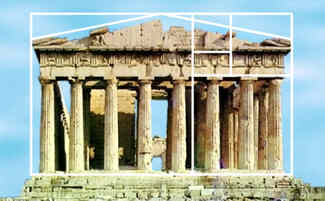
The golden ratio can be seen in architecture, as shown in the Parthenon (Golden Ratio):
Not only is math applied to
two-dimensional art, it can also be applied to other art forms, like origami
and music. I thought it was really interesting that people have been coding
simulators to computationally determine ways to fold something along a line or
plane (Lang). Knowledge of algebra and geometry are especially useful
here. As for music, mathematics is used to encode sound, for which
knowledge of binary numbers and bitwise operations would be helpful, and
determine frequencies, for which calculus and trigonometry would come in handy
(Burk).
Math can be also applied to biology. Leonardo da Vinci, a famous scientist and artist, noted that parts of the human body are related by the golden ratio too (Parveen), (Golden Ratio in the Human Head):

From this week’s lessons, I
think artists actually use a lot more math than many would realize. For
example, artists analyze angles when they’re considering the viewers’ lines of
view and perspectives. However, I don’t see art being used as much in the
sciences, except in design in tech companies.
The juxtaposition of math,
art, and science highlights the need for math in both art and science.This is particularly
interesting to me because of the huge perceived contrast between math and art,
yet math informs a lot of the basic techniques in art. Math is definitely
necessary in science too, especially subjects like physics and chemistry, but I
don’t see as much of a contrast between the two.
Works Cited
Abu Ali Hasan Ibn Al-Haitham. Digital image. Nitum. N.p., 27 Sept. 2012. Web. 12 Apr. 2015.
Burk, Phil, Larry Polansky, Douglas Repetto, Mary
Roberts, and Dan Rockmore. "Music and Computers." Music and
Computers. Columbia University, n.d. Web. 13 Apr. 2015.
Golden Ratio. Digital image. Math Is Fun. N.p., n.d. Web. 12 Apr. 2015.
Golden Ratio in the Human Head. Digital image. MATHEMATICS AND ART. University of Georgia, n.d. Web. 12 Apr. 2015.
Lang, Robert J. "Computational
Origami." Computational Origami. Robert J. Lang Origami, n.d.
Web. 13 Apr. 2015.
Parveen, Nikhat. "MATHEMATICS AND ART." MATHEMATICS AND ART. University of Georgia, n.d. Web. 13 Apr. 2015.
Vesna, Victoria. Mathematics - Zero
Perspective Golden Mean. UCLA, 9 Apr. 2012. Web. 12 Apr. 2015.
Zahoor, A. "ALHAZEN (965-1040 AD)." ALHAZEN (965-1040 AD). University of California, Santa Barbara, n.d. Web. 13 Apr. 2015.
Sunday, April 5, 2015
Two Cultures
In The Two
Cultures and the Scientific Revolution, Snow identifies two groups of
people, those who study the humanities, and those who study the sciences.
Instead of communicating with each other, the groups keep their knowledge to
themselves, which further separates them.
From an early age, I sensed this division. My parents, who are
both engineers, have always implied that artistic pursuits should just be
hobbies, and I should focus on scientific pursuits. For example, my father gave up his dream
of becoming a musician to pursue a career in chemical engineering. At UCLA,
the division is as explicit as north and south campus.
In Toward a Third Culture, Professor Vesna identifies a third, upcoming culture of
contemporary artists who are bridging the divide between the humanities and
sciences. Evidence of this new culture can be seen at UCLA through interdisciplinary courses like this class, as well as majors like Psychobiology. This is rare in public elementary, middle, and high schools, where art programs are often the first to be cut, despite evidence that early music and arts training can enhance brain development (Brown). Unicamp, UCLA's official charity, has recognized the need for this group. This summer, I'm participating in the STEAM session, which has the mission of exposing children to the intersection of the arts and sciences.

Kevin Kelly points out in The Third Culture that technology makes bridging the gap easier and faster. For example, my father still pursues music on the side, now using YouTube to instantly share his covers.
As more people incorporate technology into their everyday lives, the usability of technological products become even more important. Even though I’m starting as a software engineer,
I plan on transitioning to user experience (UX), which Google identifies in its job posting as "the synthesis of design and development". It is especially
important in this role to collaborate and communicate with designers, who
create the interface, and engineers, who build the product.

Brown, Laura L. "The Benefits of Music Education." PBS. PBS, n.d. Web. 05 Apr. 2015.
Cover I Know I'm Not the Only One by Sam Smith. Perf. Bei-Shen Sywe. YouTube, 24 Dec. 2014. Web. 5 Apr. 2015.
"Google Careers." UX Engineer, Design. Google, 25 Mar. 2015. Web. 05 Apr. 2015.
Kelly, K. "ESSAYS ON SCIENCE AND SOCIETY:The Third Culture." Science279.5353 (1998): 992-93. Web. 5 Apr. 2015.
Snow, C. P., and Roman Smoluchowski. "The Two Cultures and the Scientific Revolution." Physics Today 14.9 (1961): 62. Web. 5 Apr. 2015.
STEAM Graphic. Digital image. Manatee County. N.p., n.d. Web. 5 Apr. 2015.
UX Venn Diagram Graphic. Digital image. Code Zen. N.p., 19 Nov. 2009. Web. 5 Apr. 2015.
Vesna, Victoria. "Toward a Third Culture: Being In Between." Leonardo 34.2 (2001): 121- 25. Web. 5 Apr. 2015.
Subscribe to:
Posts (Atom)